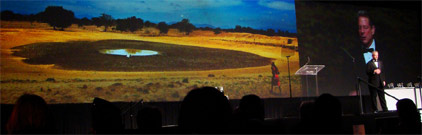
FrontlineSMS at The Feast ’09

I’ve always maintained that the greater the distance between an ICT4D ‘problem’ and the problem solver, the greater the chance of failure. The difficulty here is that quite often the problem and the resources available to fix it are in different places, and available to the wrong people.

While ‘we’ – those who rarely fully understand the problem – have easier access to the technology and funding, those who do more fully understand it don’t. This is why the current proliferation of local innovation and IT-focused business hubs across Africa is so exciting and has so much potential.

More via this short edited five minute talk I gave last year at The Feast in New York. Further in-depth thoughts on who might be best placed to run ICT4D and mobile-for-development (m4d) projects, check out this recent blog post, “Dissecting “m4d”: Back to basics“.

Ideas vs. execution: A personal history

“An idea that is developed and put into action is more important than an idea that exists only as an idea” –
Hindu Siddharta, Founder of Buddhism (563-483 B.C)

Like most people I’ve never been short of ideas. Short of good ones, perhaps, but never plain old ideas. As we all know, though, ideas alone are never enough. It’s also about execution, taking ideas and putting them into action. Like the majority of people, the majority of mine have remained just that – ideas – and sifting through some old note pads recently brought home how many I’d had over the past few years and done nothing with.

On the plus side it turns out many of my ideas weren’t mine alone, and most have since become reality for other people, i.e. those who did take that extra step and put them into action. This post is largely testament to what I didn’t do, and what others did.

Idea #1: Incubation Centre
Date: March 2008
Status: Not executed

There always seemed to be some new Centre or other going up during my two years at Stanford, and I wondered how great it would be to have one dedicated to appropriate technologies, and I briefly blogged about it in March 2008. Of course, Stanford wouldn’t have been the best place for this given the cost, so the idea slowly evolved from my crude mock-up (above) to something a little more eco-friendly based in rural Cambridgeshire. I’d still love to pursue this idea, but given the growing number of innovation hubs appearing around the world, maybe the chance has gone.

Idea #2: Mobile Sensing
Date: June 2005
Status: Not executed

On 8th June 2005, the idea for a Mobile Environmental Monitoring Device was born. MEMD would:

“… gather environmental information as people move through their landscapes. Indicators such as temperature, air quality, CO2 levels and air pressure would be recorded along with a fix on each location. For the first time individuals will be able to monitor their own exposure to local, relevant environmental hazards”

Manufacturers such as Nokia began pushing their own concepts a couple of years later, and today mobile sensing with mobile devices is nothing new. I originally blogged about MEMD – another idea whose time has passed – in more detail here.

Idea #3: SMS Competition
Date: September 2007
Status: Executed

This is one idea which was executed, in September 2007 to be precise. Its purpose was to encourage NGOs to think about how they might apply text messaging to their social change work, and the prize for coming up with something innovative was a laptop, phones, modems and cash – everything they’d need to put their idea into practice, in fact. We have been planning to run an adapted version again, but with so many mobile and ICT4D competitions around these days, we’re hesitant. NGOs have more important work to do than spend all their time trying to win things. More on nGOmobile here.

Idea #4: Mobile Payments
Date: September 2003
Status: Not executed

On 1st September, 2003 – during a field trip to South Africa and Mozambique – I put together a diagram showing how someone might pay for a newspaper using their mobile phone. Mobile payments are nothing new today, but back then very little was happening. If I’d ever wanted to be rich, this might have been the idea I should have stuck with, not that I’d ever have been able to make it happen. Further details on a blog post here.

Idea #5: Messaging Hub
Date
: October 2005
Status
: Executed

FrontlineSMS is one thing I did develop and stick with, although it was touch and go on more than one occasion. A seed of an idea during a series of trips to Kruger National Park in 2003/2004, FrontlineSMS became the first text messaging hub aimed at grassroots non-profits when it was released in October 2005. For the full story, check out this article – “And Then Came The Nigerian Elections” – from the Spring/Fall 2007 edition of the Stanford Journal of African Studies [PDF].

So, what lessons could I draw from what’s happened with my ‘Top Five Ideas’? Well, FrontlineSMS has been a fascinating journey, and sticking with that has clearly been the right thing to do. If I’d have tried to see out all of my ideas then I may well have let it slip, and ended up doing a lot of things fairly well rather than one thing very well. As my near-eight years in mobile have taught me – over and above anything else – focus is key. Swami Vivekananda, an Indian spiritual leader, sums this up better than I ever could. Take note:

“Take up one idea. Make that one idea your life – think of it, dream of it, live on that idea. Let the brain, muscles, nerves, every part of your body, be full of that idea, and just leave every other idea alone. This is the way to success, that is way great spiritual giants are produced”.

Rethinking innovation

Last week I had the incredible opportunity to talk about our work with FrontlineSMS at the National Geographic Explorers Symposium in Washington DC. A big part of what we do is to try and take the mobile message to an entirely new audience, and to help people re-think what innovation means in the developing world, using mobile technology as our lead.

It’s great to see such a revival of interest in appropriate technology, something I first became a fan of at University way back in 1997. As a sign of this growing interest, World Watch recently published one of the best and most comprehensive articles to date on “mobile technology as an appropriate technology”. You can read about that here, and it is well worth a look.

There are, of course, increasing examples of innovative applications of technology, particularly in the field of renewable energy and particularly in the developing world. Two recent and favourite examples are the solar-powered light bulb and the energy-harvesting football, both of which I’m a big fan of – not necessarily in the technology itself (although it is pretty neat), but in the approach.

Solar-powered light?

When I first heard about this I wasn’t sure if I’d read it right. A solar-powered light bulb? Well, the Nokero N100 is a solar LED bulb which can be left outside in direct sunlight during the day. This charges up its internal battery which then gives you up to four hours of light at night. It’s a brilliantly simple idea, and one which has huge potential in developing countries. Not only could it solve significant lighting issues for many households, but it also has positive health implications (replacing kerosine lamps) and, of course, potential benefits to the environment. More on the the Nokero N100 here.

Kid-powered football?

This was an instant favourite because of its sheer simplicity and brilliance. It’s not a million miles away from the Play Pumps concept, harvesting the ‘wasted’ energy of childrens’ play to generate electricity. While children kick the ‘soccket’ football around, it harvests the kinetic energy generated by the ball’s movement. A short ten minute kick-around charges an internal battery which can later power an LED bulb for up to four hours. There’s more on Soccket in this New York Times article by good friend Jim Witkin.

I don’t know about you, but I think we could do with these kinds of innovation everywhere.

Mechanics vs. motivation: The two faces of social innovation

It’s been a busy and interesting few weeks, and I’ve met many people interested in many of the subjects which also fascinate me – entrepreneurship, social entrepreneurship, innovation, Africa, mobile technology and appropriate technology, among others. Being on the road is my equivalent of the town hall meeting, of door-to-door canvassing. It’s a great way – maybe the only way – to stay connected with the grassroots and meet the up-and-coming innovators of the future. I’m beginning to realise I enjoy speaking much more outside tech circles than within them. We need to introduce social mobile to new audiences, after all, rather than continually preach to the converted.

So, what am I learning from all of this? Most of the younger people I meet want stories. Sure, they want to know some of the theory, a little about the technology. But what resonates more than anything is the background to our tools and where we get our drive and motivation from. They want to resonate, to feel closer to the possibilities and potential, to see themselves in our shoes. They want to walk away with “Well, they did it. Why can’t I?”.

This was most apparent during talks to students and faculty at Mills College, the University of San Francisco, Santa Clara University and Stanford, all packed into a three week marathon trip to the West Coast at the end of last month. What struck me were the two approaches I often witnessed to spreading the ‘innovation’ and ‘social entrepreneurship’ message. While one seems to focus on mechanics, the other focuses on motivation. Let me explain.

Click for Twitter

One or two of the events I recently attended have focused on the mechanics of innovation and entrepreneurship. This world centres on business models, the quest for data, for metrics and an obsession on measuring impact. Lots of tables, numbers, graphs, theories. The very things which score low on most people’s motivational scale. This quote, from Aaron Sklar at IDEO (which I tweeted from the conference), sums up the downside of this approach perfectly.

There certainly seems to be a mismatch between the way social innovation is taught, and the realities of how most social innovators innovate. The ‘a-ha’ moment innovators-to-be hear about is rarely the discovery of a new metric, or a new business model, or a new way of presenting or collecting data. It’s the realisation that a problem can be solved, and solved in a new way. These answers often come by doing and experiencing, being out in the field, and there are almost always stories behind why the person was there, sometimes how they got there, and what they suddenly saw which gave them their big idea.

If I’m totally honest, I find the mechanical approach a total turn-off. It grinds me down and saps any enthusiasm I have for technology and innovation. That’s not to say it’s not important – it’s vital, in fact – but you can always figure out that stuff later, once you have your big idea. No big idea, no need to worry.

Innovation and entrepreneurship start with passion, so we ought to focus more on that. We can help by speaking about our own interests, passions and stories – which most of us have – and less on the mechanical stuff (some of which, incidentally, includes the actual technology we’ve invented). This is why, I think, people tend to resonate more with individuals who succeed, rather than bigger organisations. Take the Tech Awards last month. Over a dozen people not companies – who have found a way to make a difference. The celebration of their achievements would have been less remarkable if they’d all been housed in resource-rich environments. Innovation out of scarcity is what seems to really excite people.

Al Gore at the Tech Awards. Photo courtesy godutchbaby on Flickr

Al Gore spoke at the Tech Awards gala. After a thirty minute speech not a single person could doubt his passion and commitment to the climate change cause, whether or not you agree with him. And hardly any mention of the intricacies of the science. This was a motivational speech if ever there was one. Somehow, if he’d focused on the mechanics I doubt he’d have had half the impact. Al Gore has taken a complex subject and made it accessible, and that has to be one of his major achievements.

We need to do the same with entrepreneurship, social entrepreneurship, technology and innovation. These subjects need to be demystified, and we need to put passion back where it belongs. And, in my mind, that’s ahead of just about everything else – business models, graphs and metrics included.

[Related post: “Enabling the inspiration generation“]