Glimpsing into a mobile future

Few companies innovate with the intensity and frequency of those working in mobile, and today’s present is a future that only a handful of people would have predicted just a few short years ago. While most of us happily soak up rampant innovation as mere consumers, a handful of people in the hallowed corridors of mobile R&D labs are already working on the next big thing – the phones we’ll be carrying around in our back pockets in 2012 and beyond.

Very occasionally we get a glimpse of this future. A couple of years or so ago, Nokia went public with their “morph concept” phone – an idea which seems so crazy and off-the-wall it might actually be possible. Who knows, maybe it’s being field tested right now, although we wouldn’t know it. A morphing phone could disguise itself as anything from a watch to a handbag, making spotting one incredibly difficult.

As Alan Kay once famously said, “The best way to predict the future is to invent it”. While a handful of people do precisely that, the rest of us are left to speculate. Ask people what that mobile future might look like, and we’ll likely get answers that take us in one of two directions. Adults will probably be constrained by the parameters of what they see around them today, so predictions on what a mobile phone might look like in, say, ten years, would most likely center around smaller, lighter and faster. Children, on the other hand, would probably let their imaginations run riot and talk about phones that are invisible, implanted in our brains, or both. Maybe it was a children’s focus group that came up with Nokia’s morphing phone idea. Regardless, I’d go with the kids’ instinct over an adult’s any day.

Technology doesn’t evolve in a vacuum, of course, and it’s only when it finds its way into the hands of people that it really gets interesting. In order to understand what users need and want from their next mobile device, we need to get in the field and ask, as some mobile manufacturers do. Anthropology, with its human-centered approach to research, has become quite a trendy discipline in the mobile world, particularly when it’s done in exotic emerging markets.

The irony of this approach is that, perhaps for the first time, the needs of the consumer in the developing world are beginning to drive innovation and thinking at home. With concerns about global warming, energy dependence and the environment rising up the political agenda, mobile manufacturers find themselves tackling the very same problems as they design for the developing world. These markets by their very nature demand greener, recyclable, longer-lasting, energy-efficient mobile phones. Today technology transfer works both ways, and it’s increasingly heading in our direction.

The future isn’t all about hardware, of course. Some of the most exciting innovations we’ve seen in recent years have come from mobile services. Innovation for many is centered more around what you can do with a mobile device, rather than what you can make out of one. Financial services, for example, promise to “bank the unbanked” and provide unprecedented access for some of the poorest members of society in many developing countries. Mobile banking in places like the U.K. and U.S. lags some way behind.

My belief is that many future mobile innovations will be borne out of the realities of the developing world. In my “developed” world, where friends leave household appliances on standby for weeks on end, energy efficient mobile devices are seen as something of a luxury. For a mobile phone owner in, say, Uganda – with little access to mains electricity – it’s more of a necessity.

I also believe – along with many others – that as devices get smarter, faster and more powerful, the challenges of power consumption will continue to consume large chunks of R&D effort. A recent announcement from the Chinese Academy of Sciences of a highly-efficient solar cell that can effectively be embedded in plastic could give us a glimpse of a future where the entire housing of mobile phones become one large solar panel, along with our clothes. Advances in harnessing kinetic energy could also give us self-charging mobiles, akin to our already-present self-winding watches. Perhaps the challenges of keeping mobile devices powered up will lead to a convergence where a number of charging technologies are present in a single device.

Looking even further ahead, mobile devices may also be chargeable wirelessly over distance. Perhaps by a method of charging via the same wireless networks that carry our mobile signal. I’d hate to think about the health implications of this, or how inefficient these charging networks might be, but it’s not out-of-the-question that this becomes reality. Again, this technology would most likely emerge from developing countries, where vast numbers of potential customers are excluded from phone ownership because they lack of access to power to charge them. Whether this wireless charging future happens before the converged renewable option discussed remains to be seen.

Winding the clock back to my childhood, and returning to the original question of what the future might look like, a young Ken Banks might draw a picture of a single device that seamlessly docks, morphs or switches between fixed desktop and portable wireless device.

Despite the march of the integrated mobile device, we’re still some way off making them as easy and convenient to use as our old friend the computer. The fact that I choose to write this on my laptop is a case in point. Once I leave my laptop at home – assuming I own one – and start writing regularly on my phone, maybe I’ll finally know that my future has arrived.

Mobile community: The holy grail of m4d?

Last week I wrote a post on the difficulties of running a “mobile for development” – or m4d – project. I tried to make it challenging, and was hoping to stir up some discussion around the merits of mobile-initiated development projects versus development-initiated mobile projects. You can read that post here.

Unless you’re one of the bigger technology blogs – Mashable, TechCrunch, Scobleizer and so on – it’s hit-and-miss whether or not a post will get the traction you’re looking for. Apart from a couple of dozen tweets and a dozen or so comments, the post didn’t generate as much debate as I’d have liked. But it did get me thinking – if these kinds of discussion weren’t taking place here, then where were they taking place?

I’m regularly asked at conferences for hints on the best sites for people to post questions and stimulate debate around mobile technology, and I always struggle to give an answer. It seems crazy that, for a discipline which began to fully emerge probably about seven or eight years ago, there still isn’t a genuinely active, engaging, open online community for people to join and interact with each other.

In order to get a sense of which communities exist, I recently sent out a message to a number of ICT4D and mobile email lists I subscribe to, and posted the odd message on Twitter. Very few people could suggest anything. A few people mentioned email lists which dealt specifically with sectoral issues, such as health, but not specifically with mobile (although mobile was a regular thread in many discussions). Only MobileActive suggested MobileActive, which was a surprise considering its positioning as a global, mobile community with over 16,000 ‘active’ members.

Finding nothing was only part of it – many people clearly had different ideas of what made up community, too (I’d put this down to a challenge of definition). When I pushed out my call for sites, I specifically asked for those which were “open, active, collaborative and engaging”, things that I thought would be pre-requisites for anything worth being a member of.

According to Maddie Grant, a Strategist at SocialFish, a consulting firm that helps associations build community on the social web:

What makes a community open is when there’s “a lot more outside the login than inside”, so most of a community’s content must be at least viewable and shareable without logging in. To be active, most of a community’s content must be member (user) generated, not owner-generated, and must have some degree of conversation which includes comments, discussions and reviews

Going by these criteria I don’t believe we yet have a truly active, engaging, open mobile community. This seems a little strange when you consider the attention the technology has been getting over the past few years.

On the flip side though, it might not be so strange after all. As Jonathan Donner put it to me in a recent email, “Why should m4d have it’s own groups and community sites? Can’t we – or should we – just mainstream ourselves into ICT4D?”.

This discussion clearly has a long way to go. I just wonder where that discussion will take place.

Dissecting “m4d”: Back to basics

Do the majority of people working in “mobiles for development” work in mobile, or development? It may seem like an odd question, but how people approach “m4d” may have more of an impact on success or failure than we think.

The world of social mobile isn’t short of anecdotes. “Put the user first”, “Consider the technology only at the very end”, “Don’t re-invent the wheel” and “Build with scale in mind” are just a few. Ignore these and failure won’t be far around the corner, we’re told. But maybe we’re missing something here. Sure, there’s a growing number of ‘best’ practices, but one thing we rarely seem to question are the very credentials of the project origin itself.

Everyone from donors to project managers and technologists to journalists are keen to identify traits or patterns in ‘failed’ mobile projects. Many of their conclusions will point to poor planning, poor technology choice or lack of collaboration, but sometimes the biggest failure may have taken place long before anyone got near a mobile phone.

What I wonder is this. Do we know what ratio of “m4d” projects are initiated by development practitioners (or sectoral experts in health, agriculture, conservation and so on) as opposed to mobile technologists, and what impact does this have on the success or failure of the project? In other words, if the problem solver is primarily a mobile technologist – the “m” part of “m4d” – then you might assume they have much less understanding of the on-the-ground problem than a development practitioner or sectoral expert might – the “d” part.

Does this bear out in reality? If failure does turn out to be higher among technologists then this is a relatively easy problem to fix, whereas many of the other perceived reasons for failure are not. It’s all about getting back to basics.

(Click here for more observations on mobile development).

I’ve always maintained that the people closest to the problem have the best chance of coming up with a solution, and this probably bears out in many cases, particularly in the ICT4D field. Ushahidi, started by Kenyans to solve a Kenyan crisis – and DataDyne, a health-based data collection solution designed by a paediatrician – immediately spring to mind. In these instances, being up-close and dirty with the problem came well in advance of any technology-based solution to it. The same goes for our very own FrontlineSMS initiative, borne out of a series of visits to South Africa and Mozambique back in 2003/2004.

In any discipline, the greater the rate of innovation the greater the problem of focus, and mobile is no exception. As Bill Easterly put it in a recent post in response to questions from students about how they might help “end world poverty”:

Don’t be in such a hurry. Learn a little bit more about a specific country or culture, a specific sector, the complexities of global poverty and long run economic development. At the very least, make sure you are sound on just plain economics before deciding how you personally can contribute. Be willing to accept that your role will be specialized and small relative to the scope of the problem. Aside from all this, you probably already know better what you can do than I do

This is great advice, and not just for economists. If mobile and health is your thing, focus on health and get very good at it. If it’s mobile and agriculture, or mobile and election monitoring, do the same. Whatever your area of interest, get out and understand the issues where they matter – on the ground – and don’t get totally sidetracked by the latest trends, technologies or disciplines. Whatever the reason for your interest in ‘mobiles for development’, make sure you don’t forget the importance of understanding the ‘development’ bit.

Focus is highly underrated, and often debates around technology choice, open source, challenges of scale and “understanding your users” are distractions from a much-less discussed but equally vital question. And that’s this.

“Who’s best placed to run a successful “m4d” project – the m‘s or the d‘s?”.

“Inappropriate” appropriate technology?

For some time things have been hotting up in the mobile for development space, and new tools are emerging all the time. But while these solutions extend all the way across the technological spectrum, almost all claim to be “appropriate” in one way or another. Clearly something isn’t right.

An appropriate use of Twitter?

For a while it was “scale”, and then “enabling environments”, and now it seems to be all about “appropriate technology”. I remember studying sustainable development at university, and coming to the conclusion that the term was so widely misunderstood and overused, it had almost become meaningless. I think we’re in danger of having the same thing happen with many of the terms we wildly band around in mobile. Part of the problem is that people are rarely asked to justify their positions or claims, so we never really quite know what anyone means.

In a recent PC World article I wrote, entitled “Appropriate Technology and the Humble Mobile Phone” funnily enough, I broadly defined appropriate technology as “anything that is suited to the environment in which it is used”. There are many factors that need to be considered in deciding how suitable something is – how complex it is to use, whether it can be used largely unaided, whether it can be fixed or maintained locally, how easily it can be localised, whether it can stand the field conditions, and so on.

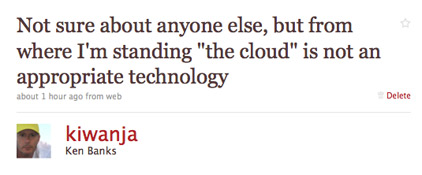
You could also add to that whether or not the underlying infrastructure is in place for the technology to actually work. Makes sense, no? If we take anything that uses “the cloud“, for example, then I’d argue that it’s largely “inappropriate” unless you’re working in predominantly urban areas or in predominantly ‘developed’ countries. Many of the projects I see are aimed largely at the opposite – developing country and rural. On top of that, many of the areas where I’ve worked have little or no Internet access of any description, and very few people have devices that could access it, even if it was there.

In a recent must-read post – “The sun is shining in Africa” – Miquel provides some compelling arguments as to why “the cloud” is not an appropriate technology for much of the developing world:

The other big point missed in all this Cloud business is how it’s screwing the rest of the world outside of well, the US, and maybe Europe. This is the problem in how when people who proselytize a new technology don’t know understand the underpinnings of it, they often miss big gaping holes in the actual implementation of it

Maybe it’s no coincidence that there’s been a rise in use of “the cloud” and “appropriate technology” terminology at the same time. Let’s just get one thing straight, though. Technologies that use “the cloud” are not bad technologies, just as technologies which base themselves on simple SMS aren’t either. People that build and promote mobile technologies for developing regions just need to be clearer where their target audience are, and base their technology choice on what works – and what’s available – in the places where those people live and work.