“After all is said and done, a lot more will be said than done” –
Unknown author
Twitter has been abuzz lately with fascinating snippets of advice on how to succeed, how not to fail, what makes a good social venture, what makes a good mobile project or how to be a successful social entrepreneur. Of course, it’s easy to say these things, and even easier to repeat mantras and slogans which fit a popular or emerging philosophy. Who could argue, for example, that “users should be put first”?
Sadly, when all is said and done, the reality is that it’s still much easier to ignore the advice and go do your own thing your own way, rather than doing things the right way.
The best way to get a sense of the true philosophy – the DNA – of a project is to see if it passes a “taste test”. This is particularly true in mobile, where almost all initiatives claim to have engaged or active communities, or to empower, to put users first, or to have been ‘born’ in the field. The question is: Does the rhetoric actually match the reality? In an age where more and more projects are coming under increasing scrutiny, ensuring they are properly positioned is crucial.
It’s quite easy to determine whether or not a tool is going to be of any use to an end user (an NGO in this case), or whether you’d need a medium to high degree of technical literacy to make use of it (in which case you might argue that the tool was more developer-focused). For some time I’ve used the concept of the “social mobile long tail” to graphically represent this.
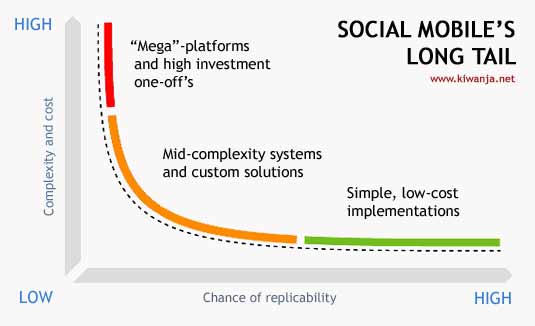
In short, tools in the red area are technically and financially out-of-reach of many grassroots NGOs, many of whom sit in the green space. Tools at the higher end of the graph are generally more complex, server-based systems which require a high degree of technical competence, and often the Internet, to set up and use. Tools in the lower end are simple, low-cost, need few technical skills, work on easily available hardware, don’t require the Internet, and are easy to install and run. Tools in the green space can be quickly adopted and replicated – within hours – whereas tools at the other end need much more planning, i.e. more people and more lead time, and most likely a degree of training.
So, how might we determine where a tool should be placed on the “social mobile long tail”? There are likely many measures and metrics, but I’d say these are a few of the more obvious ones the user would be principally concerned with:
- Does the project have a user-facing, NGO-friendly website?
- How technical is the language on the site?
- Is there an easily accessible, open, visible user community?
- How easy is the software to find, download and install?
- Will it work on widely available hardware and software in the places where it will be used?
- Can the user independently deploy the tool if they want to?
For some time I’ve wondered whether it would be worth scoping out the mobile landscape and plot available tools along the tail. Not only would it satisfy my general curiosity, but it could be immensely valuable to an NGO community which still largely struggles to understand the mobile technologies they believe – and hope – they should be using.



 “Over the next few months we will delve into the human stories behind the growth of mobile technology in the developing world. We’ll take a closer look at the background and thinking behind FrontlineSMS, and hear from a number of users applying it to very real social and environmental problems in their communities. We will also hear thoughts and insights from other key mobile innovators in the field, from anthropologists to technologists to local innovators.”