FrontlineSMS: Now with Forms

It’s been a hectic few months, but we’re finally there. Today we’re excited to announce the release of the new FrontlineForms, an SMS-driven data collection tool which seamlessly integrates into our existing and growing FrontlineSMS platform.

Sure, data collection tools already exist, but many require mobile internet access to function, degrees in Linux to get running, or PDAs or the kinds of phones that just aren’t available to the masses in most developing countries. FrontlineForms runs on most high- and low-end Java-enabled phones, can be downloaded directly onto a handset over-the-air, doesn’t require internet access beyond installation, and utilises the already-proven simple user interface of FrontlineSMS. In short, FrontlineForms compliments our existing focus on empowering the social mobile long tail with an entry-level, usable data collection tool.

According to my thinking, tools for the long tail need – among other things – to run on readily available hardware wherever possible, and be simple to install and easy to use. These innocent little criteria can create huge challenges, though. Writing an application which runs on all desktops (Windows, Mac and the various flavours of Linux), that interfaces locally with the widest range of phones and modems, and connects remotely with a data collection tool which runs on as many Java-enabled handsets as possible is a huge technical challenge. Many other mobile solutions concentrate on one desktop operating system, or a small family of mobile phones (sometimes just a single phone), which is all fine if you want to concentrate on users higher up the long tail. With our focus on grassroots NGOs, we don’t.

FrontlineSMS Forms Editor

So, this is how it works. Using the new FrontlineSMS Forms Editor (above), users are able to create a form visually on their computer by dragging-and-dropping field types, giving them names and setting other parameters along the way. The form is then encoded and sent via SMS to any number of handsets running the FrontlineForms client, a small program which runs on a wide range of Java-enabled handsets. Once these handsets receive a new form, the Java client interprets the data, saves the form layout and displays a mobile version ready for the fieldworker to complete (see below).

FrontlineForms Client

The FrontlineForms client can hold many different forms at the same time, all selectable from a drop-down menu. As requirements change new forms can be built and distributed by simply texting them to the recipients handset through FrontlineSMS – they don’t need to travel to the office to be added. Once out in the field the user simply inputs their data, and once complete multiple forms are combined and compressed, ready to be sent back to the FrontlineSMS hub, again as SMS. If at any time users find themselves working out of range of a mobile signal, the data is usefully held in “offline” mode until connectivity is restored.

The addition of data collection functionality to FrontlineSMS is a significant step forward for the software. From today, non-profit organisations in the developing world can experiment with anything from simple two-way group messaging campaigns to prototyping SMS-based information services, or start collecting data in the field, all through a single software application. The modular nature of FrontlineSMS means that users are able to deactivate functionality they do not need, but then easily reactivate it as they grow into SMS services. Future “modules” will include mapping functionality – powered by Ushahidi – and multimedia messaging (due later this year) allowing the transmission of pictures, audio, video and text. More specialist applications, including those being developed independently by the FrontlineSMS:Medic team, will also appear as optional modules.

According to Dr. Luis Sarmenta of the Next Billion Network and MIT Media Lab – whose students worked on pre-release versions of the tool as part of their own projects:

“Data collection from the field is one of the most common needs we see among projects in the developing world today, and enabling people to use mobile phones instead of paper would empower a lot of groups and people out there to do their work more efficiently, more effectively, and with broader reach. FrontlineForms seeks to provide this profoundly useful capability while remaining true to the goal of ease-of-use that has been the key to FrontlineSMS’ success and value”

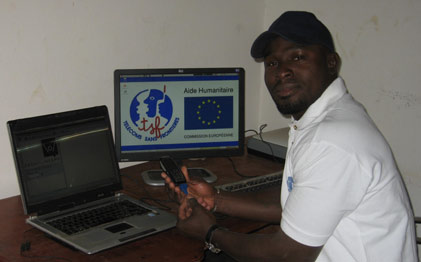
Télécoms Sans Frontières (TSF) were equally positive after spending several days putting the entire platform through its paces as part of a wider evaluation exercise. According to Grégory Rebattu, TSF’s Niger Representative:

“Crucially from our perspective, FrontlineSMS is extremely user-friendly, allowing partner organisations on the ground to rapidly deploy a data collection and dissemination system from scratch. This simplicity is crucial for organizations which may lack technical skills, and users can be up and running in a matter of minutes with the minimum of mouse clicks. The intuitive nature of the software also means that little technical support is required once they’re up and running”

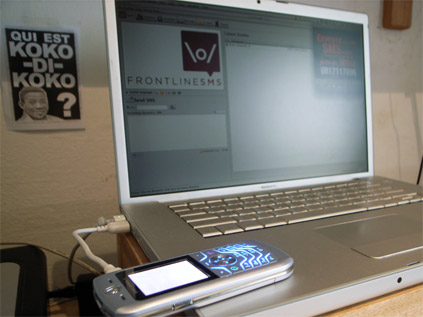
FrontlineSMS Icon - Photo by Erik Hersman (White African), Kenya, 2008

Today’s release of FrontlineForms gives many new and existing FrontlineSMS users access to entry-level data collection tools for the very first time. Those that find it valuable, and those whose data collection needs grow, can then move onto more scalable and powerful solutions such as those developed by DataDyne, an organisation we’ve been in contact with over the years and whose work is making a considerable impact in parts of the developing world. What FrontlineForms aims to do, over-and-above anything else, is give grassroots NGOs the opportunity to try out mobile data collection with the minimum of fuss, the minimum need for high-level technical expertise or equipment, and the minimum of funding.

These are exciting times for the FrontlineSMS community. The software has been allowed to develop organically, based very much on the needs of  users in the field, and it continues to power increasing numbers of social change projects around the world. If 2009 doesn’t turn out to be the “Year of Mobile” everyone is talking about, we’ll sure be doing our best to make it the “Year of the FrontlineSMS user”.  \o/

(Further details on today’s FrontlineForms launch can be found on the official Press Release. A special thanks goes to Tess Conner for her work on media and PR, to MIT and Télécoms Sans Frontières for their feedback, to the team at Masabi for their commitment and contribution to the project, to members of the FrontlineSMS Communiity for their ideas and enthusiasm, and to members of the wider social mobile community for their continued support and encouragement. You know who you are)
TSF, FrontlineSMS and humanitarian assistance in Niger

In this – the third in our series of FrontlineSMS guest posts – Grégory Rebattu, Télécoms Sans Frontières (TSF)’s Niger Representative, and Oisín Walton, Head of TSF Communications and International Relations, talk us through their thoughts on the software, and its potential for emergency relief in Niger.

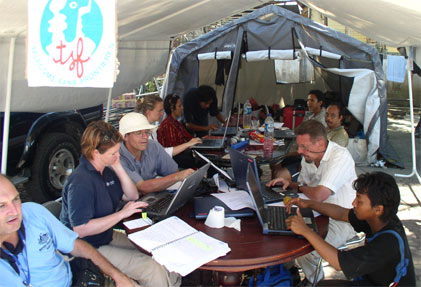
“I work for Télécoms Sans Frontières (TSF), the leading NGO specialising in the deployment of telecommunications in emergencies, and head-up TSF’s base here in Niger. In emergencies, telecommunication networks are often seriously damaged or destroyed. Some humanitarian crises also strike in areas with no existing communication facilities. Today, TSF plays a key role in strengthening coordination and communication by deploying telecommunications centres within 48 hours of an emergency.  These centres offer broadband Internet access, voice communications, fax lines and all the IT equipment needed for a field office.

Telecoms Sans Frontieres

Our base in Niger is more involved in longer term projects particularly in strengthening food crisis prevention systems. Niger is ranked 174th out of 177 nations on the United Nations Development Programme’s Human Development list – making it one of the least developed countries on Earth. The living conditions in the Sahel desert are extremely harsh and recurrent drought leads to almost permanent food insecurity. Less than 12% of the territory is cultivable – so the widely reported current food crisis hits Niger particularly hard.

Telecommunication networks are also very much in their infancy, although GSM coverage is now on the rise and bringing infinite new opportunities for the humanitarian and development sectors. In particular, we believe that text messaging – used in conjunction with cutting-edge tools such as FrontlineSMS – are particularly powerful, enabling the collection and dissemination of data quickly and easily with very low running costs. Over the past few weeks we have been working closely with the FrontlineSMS team, putting the software through its paces and assessing its suitability in our work. We have been particularly excited by the new “FrontlineSMS Forms” data collection functionality which we helped test and which is being released next week.

Crucially from our perspective, FrontlineSMS is extremely user-friendly, allowing partner organisations on the ground to rapidly deploy a data collection and dissemination system from scratch. This simplicity is crucial for organizations which may lack technical skills, and users can be up and running in a matter of minutes with the minimum of mouse clicks. The intuitive nature of the software also means that little technical support is required once they’re up and running.

I have already presented the application to a group of NGOs and UN agencies who are very excited. These organizations – who work in a wide range of sectors including health, nutrition and agriculture – immediately saw the immense potential of FrontlineSMS and how it might enhance their capacity to save lives and develop local economy, not to mention their capacity to improve the security of their own staff.

On that note, our first FrontlineSMS initiative is about to launch, and will provide an SMS security alert forwarding service to Niger’s NGO community. This will allow aid workers to instantly warn the community about security issues in real time.

Gregory, TSF Niger

Concretely, we see other immediate applications for FrontlineSMS in Niger. These include the use of the new Forms feature for data collection for the National Health System which collects and monitors the number of cases per pathology in health structures. FrontlineSMS could also be used to collect market prices, and even to disseminate those prices to small farmers.

We are also planning to test its interoperability with satellite phones which will allow us and our partner organizations to extend its usage into areas not covered by mobile networks. We also plan to use it in our responses to sudden-onset emergencies where mobile networks are often disrupted.

Summing up, FrontlineSMS is a fabulous tool and one which presents huge opportunities to non-technical NGO users. Saying that, don’t be fooled by its simplicity – as well as standard incoming and outgoing group messaging, it has plenty of advanced and extremely powerful functionality. From our testing and evaluation, and our discussions with partner organizations, it looks like FrontlineSMS has infinite applications in the humanitarian world, and this is great news for those we are trying to help.

As we often say here, it’s now no longer a question of technology, it’s a question of imagination!”

Grégory Rebattu, Niger Representative
Oisín Walton, Head of Communications & International Relations
Télécoms Sans Frontières
www.tsfi.org

Sitcoms+SMS: Tackling HIV/AIDS in the DRC

In this, the first of a series of guest posts on how FrontlineSMS is being used around the world, Becky McLaughlin – Marketing Director at Rien que la Vérité – talks about their current use of the platform, and the impact it has had on their work

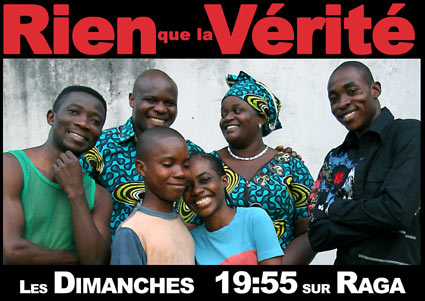
“Based in the Democratic Republic of Congo, Rien que la Vérité was born in 2006 when some of the finest musicians in the Congo united to produce a CD of songs speaking against the spread of HIV/AIDS. Since 2006, the Rien que la Vérité platform has produced 14 music videos, a documentary, and an all-day stadium concert. In its present incarnation, Rien que la Vérité is touching the lives of the people of the Congo through their television screens as they follow the lives of a Kinois family on a locally-produced TV drama.

rqlv_family_ad

Rien que la Vérité – the TV series – launched nationally on November 30th, 2008 and first implemented FrontlineSMS in the airing of its second episode on December 14th. Each episode broadcast is accompanied by short talk-show segments during which a host introduces music clips, talks to well-known musicians and actors, and interviews representatives from local NGOs and organizations whose message dovetails with a theme introduced in the show.

During the December 14th show, the audience was invited to participate by sending an SMS with the name of their favorite character. The responses were collected using FrontlineSMS. This simple first step allowed Rien que la Vérité to test the software and to begin an exploration of our audience’s perceptions and preferences. As the show continues we plan to introduce more simple polls that will help tailor the show to the audience’s tastes, and give viewers a sense of ownership of the program.

drc-tv-frontlinesms

This, however, is the most basic use we foresee. We are now launching a drive to support fan clubs, so that people who watch the show can find each other, meet, and talk about the show and the topics it introduces – a process that will begin to normalize conversation about HIV/AIDS. We’ll use FrontlineSMS to collect contact information from interested fans, then broadcast messages with times and locations for local club gatherings. We also intend to use FrontlineSMS in our research for measuring the impact the show has on our target audience. We’ll send out questions via SMS to fans before and after each show, measuring any changes in attitude, knowledge, or self-reported practices due to exposure to the show’s messaging.

FrontlineSMS will be a critical tool in our goal to entertain and educate. Like its television format, Rien que la Vérité’s future development must remain grassroots, and FrontlineSMS is an excellent vehicle for this.”

Becky McLaughlin
Marketing Director
Rien que la Vérité
www.abcd-laverite.com

Spreading the [text] message

I often get asked the advantages of FrontlineSMS over the standard ‘Group’ messaging functionality of some (notably Nokia) mobile phones, or the supplied Handset Manager software. It’s an obvious question if you just see FrontlineSMS as a simple Group messaging hub. Not until you use it, or dig a little deeper, do you realise it’s a lot more than that.

(Larger version available here)

One of the great strengths of the software are “keyword actions” – the things that can be done with an incoming text message. For example, automatic replies can be triggered (with any message of your choosing), the incoming text can be forwarded as a new SMS to a predefined Group of people (which is what Twitter used to do for the masses before they pulled the plug), the message can be forwarded to any email address or email distribution list/group, the message can be sent to an online Twitter account or update your Facebook status, or posted to a web service/site such as Ushahidi, or passed on to another application running on the local computer (or written to an external database). Any combination of these actions can be triggered, making FrontlineSMS extremely flexible.

Once the new year (and the new Hewlett Foundation funding) kicks in, we’ll be working on a range of user-requested enhancements. FrontlineSMS remains very much work in progress. Watch this space – in 2009 there’s much more to come… \o/