Invention. Collaboration. Integration.

The past couple of weeks have been particularly exciting for Ushahidi and FrontlineSMS. Independently they’ve been featured on the BBC and CNN websites, where their use in the DRC and Malawi respectively continues to gain traction. Jointly they’ve appeared in Forbes Magazine in an interview given by Ory (which was predominantly about Ushahidi, but given the enormous openness and spirit of collaboration between the two projects, the FrontlineSMS integration also made it to print).

I’ve been a big fan of Ushahidi – particularly the people behind it – long before they started using FrontlineSMS as their local SMS gateway. I wrote about the project when it came to prominence during the Kenyan election crisis, and included it (along with FrontlineSMS and Kiva) in a discussion about rapid prototyping – something I’m a huge fan of – in one of my PC World articles:

The interesting thing about these three projects [Ushahidi, Kiva and FrontlineSMS] is that they all proved that they worked – in other words, proved there was a need and developed a track record – before receiving significant funding. Kiva went out and showed that their lending platform worked before major funders stepped in, just as FrontlineSMS did. And Ushahidi put the first version of their crowd sourcing site together in just a few days, and have reaped the benefits of having a working prototype ever since. If there is a lesson to learn here then it would have to be this – don’t let a lack of funding stop you from getting your ICT4D solution off the ground, even if it does involve “failing fast”


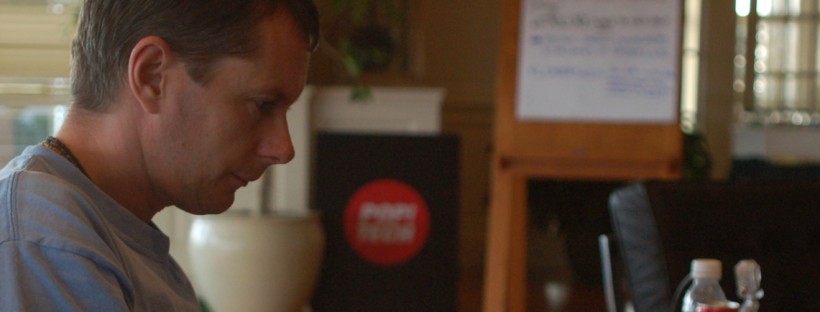
Given Ushahidi’s Kenyan roots (and those of the Founders) and its growing collaboration with FrontlineSMS, it was more than a little apt that last week saw three of us working together at a Plan International workshop near Nairobi (photo, above, of us at a separate Ushahidi developer meeting). Erik Hersman, Juliana Rotich and myself didn’t only present Ushahidi and FrontlineSMS as standalone tools to the Plan staff, but also demonstrated how easily and how well the two could work together. It was the first time the three of us had collaborated like this, and the first time that I’d seen a FrontlineSMS/Ushahidi sync running in the field. As Erik himself commented:

One of the basic tenants of Ushahidi’s Engine is to make it open to extend through other mobile phone and web applications. The first one we’ve done this with is FrontlineSMS, which has worked out incredibly smoothly for us. Within a week of releasing our alpha code, we deployed Ushahidi into the DR Congo, and used a FrontlineSMS installation locally to create the hub for any Congolese to report incidents that they see. It has worked flawlessly…

During our presentation, Plan International staff were able to text messages into the FrontlineSMS hub at the front of the room, messages which were then automatically posted via the internet to the Ushahidi server. Erik approved some of the comments (not all!) via the online Ushahidi dashboard from the back of the room, and the attendees saw them appearing on a Ushahidi map beamed via a projector onto the wall. Although live demonstrations are risky at the best of times, the sync took two minutes to set up, and everything worked perfectly. For everyone behind the Ushahidi and FrontlineSMS projects, months (and in the case of FrontlineSMS, years) of hard work was paying off right before our eyes.

Graphic courtesy Ushahidi

For the workshop delegates, the potential of the two tools – independently and together – was clear, and ideas for their application in Plan projects across Africa continued to flow for the rest of the week. What’s more, the benefit of working together to demonstrate the independent and collaborative power of the tools was clear to Erik, Juliana and myself. An innocent Tweet about “Ushahidi/FrontlineSMS Road Shows” brought back encouraging words, and even an offer to try and help make it happen.

There’s much talk of collaboration and integration in the mobile space, and things are slowly beginning to happen. The recent establishment of the Open Mobile Consortium is further proof of a growing collaborative environment and mentality. What took place last week in Lukenya is just a small part, but one that I – and the team behind Ushahidi – are immensely proud to be a part of.

Mobile applications development: Observations

Technology and democracy: both great in theory, a little harder in practice. One of the key challenges is that one successful model doesn’t – by default – work somewhere else. For mobile techies, if we can’t easily ‘transplant’ a solution from one place to another, where does our “figure out what works” mantra leave us? What relevance does it have? Have we ever managed to “figure out what works” and make it work somewhere else, geographically? Is it even possible, or is it just a good industry sound bite?

Progress in the social mobile field will come only when we think more about best practices in the thinking and design of mobile projects and applications, rather than obsessing over the end products themselves. By then most of the damage has usually already been done. In my experience, many social mobile projects fail in the early stages. Lack of basic reality-checking and a tendency to make major assumptions are lead culprits, yet they are relatively easy to avoid. I would argue that successful mobile projects – those aimed at developing countries in particular – have a better chance of succeeding if some or all of the following are considered from the outset.

Women queue for water in Bushbuckridge, South Africa (photo Ken Banks, kiwanja.net)

Firstly, think carefully if you’re about to build a solution to a problem you don’t fully understand.

Check to see if any similar tools to the one you want to build already exist and, if they do, consider partnering up. Despite the rhetoric, all too often people end up reinventing the wheel.

Be flexible enough in your approach to allow for changing circumstances, ideas and feedback. Don’t set out with too many fixed parameters if you can help it.

From the outset, try to build something that’s easy enough to use without the need for user training or a complex manual, and something which new users can easily and effortlessly replicate once news of your application begins to spread.

Think about rapid prototyping. Don’t spend too much time waiting to build the perfect solution, but instead get something out there quickly and let reality shape it. This is crucial if the application is to be relevant.

Never let a lack of money stop you. If considerable amounts of funding are required to even get a prototype together, then that’s telling you something – your solution is probably overly complex.

Learn to do what you can’t afford to pay other people to do. The more design, coding, building, testing and outreach you can do yourself, the better. Stay lean. These tasks can be outsourced later if your solution gains traction and attracts funding. The more you achieve with few resources the more commitment and initiative is shown, increasing the chances a donor will be attracted to what you’re doing.

Don’t be too controlling over the solution. Build an application which is flexible enough to allow users, whoever and wherever they may be, to plant their own personalities on it. No two rural hospitals work the same way, so don’t build an application as if they did.

Think about building platforms and tools which contribute to the solution for the users, rather than one which seeks to solve and fix everything for them. Let them be part of it. Think about how your imported solution looks to a local user. Are they a passive recipient of it, or can they take it and turn it into their solution? A sense of local ownership is crucial for success and sustainability.

Ensure that the application can work on the most readily and widely available hardware and network infrastructure. Text messaging solutions aren’t big in the social mobile space for nothing. And, for the time being, try to avoid building applications which require any kind of internet access, unless you want to restrict your target audience from the outset.

Every third party the user needs to speak to in order to implement your solution increases the chances of failure by a considerable margin, particularly if one of those parties is a local mobile operator.

Be realistic about what your application can achieve, and wherever possible look for low-hanging fruit. Remember – big is not better, small is beautiful, and focus is king. A solid application which solves one element of a wider problem well is better than an average application which tries to solve everything.

Bear in mind that social mobile solutions need to be affordable, ideally free. Business models, if any, should be built around the use of the application, not the application itself. Easier said than done, so try to engage business studies graduates at universities, many of whom are always looking for cool social-change projects to work on.

Leverage what local NGOs (or users) are best at, and what they already have – local knowledge, local context, local language and local trust among local communities. Remember that it’s unlikely you will ever understand the problem as much as they do, and that it’s always going to be easier to equip them with tools to do the job than it will ever be for you to learn everything they know.

Don’t waste time or energy thinking too much about the open sourcing process (if you decide to go that route) until you know you have something worth open sourcing. (And, by the way, the users will be the ones to let you know that).

Don’t build an application for an environment where it may politically (or otherwise) never be adopted. For example, a nationwide mobile election monitoring system would need government buy-in to be implemented. Governments which commit election fraud to stay in power are unlikely to adopt a technology which gives the game away.

Consider controlling distribution and use of your application at the beginning. Not only is it a good idea to be able to contact users for feedback, donors will almost always want to know where it is being used, by who and for what. Neglect to collect this data at your peril.

Promote your solution like crazy. Reach out to people working in the same technology circles as you, post messages on relevant blogs, blog about it yourself, build a project website, try and brand your solution, and make use of social networking tools such as Twitter and Facebook. Although your target users may not be present, many are likely to be fairly resourceful, and the more people talking about your solution the more likely news is to filter down to them.

Finally, build a community around the application, encourage users to join and share experiences, and to help each other. Don’t be afraid to reach out for additional information, and work hard to keep it active, engaging and growing. Communities are notoriously hard to build, but when they work they’re worth it.

This blog post is also available as a PDF.

Note: I followed up on this post with an article for PC World – “Social Mobile Applications: The Missing Book“. (An index of all kiwanja PC World articles is available here)

In the know

We read a lot about the delivery, and popularity, of SMS services such as market prices, health advice and job alerts in developing countries, information there is clearly a need for. These are the services you’ll get to hear most about when you search the web, trawl the blogosphere and attend various conferences on the subject. It all seems pretty sewn up on the content side – I mean, what else could people earning a few dollars a day (at most) possibly want?

I remember my days back in Nigeria, where I worked for the best part of 2002 at a primate sanctuary in Calabar. The mobile phone networks weren’t quite operational yet – there was sometimes a signal and sometimes it worked – but the number of internet cafes was on the rise. I remember going in during the evenings, usually to find people doing one of four things – entering competitions to win cars or holidays, looking at females (and males) in varying degrees of undress, trying to find a partner on a dating site, or sending and receiving email (which was perhaps, in some cases, related to one of the first three activities). Clearly, this wasn’t the only use of the internet in Calabar, but nevertheless it interested me to see what people did online once you gave them the opportunity to get there. Let’s put it this way, few people were doing their homework, looking up university education options, checking the price of matoke or learning how to stay fit and healthy.

Last Autumn I met Rose Shuman, a young entrepreneur based out of UC Berkeley, California. With a background working in developing countries and a Masters in International Development from Brown University, Rose had developed a clever ‘intercom’ style box which, when placed in a rural location, allowed people access to the information they sought in a slightly unusual, but innovative manner. It was a ‘one-step-removed’ type of internet access.

It works like this. A villager presses a call button on a physical intercom device, located in their village, which connects them to a trained operator in a nearby town who’s sitting in front of a computer attached to the internet. A question is asked. While the questioner holds, the operator looks up the answer on the internet and reads it back. For the villager there is no keyboard to deal with. No complex technology. No literacy issues. And during early trials at least, no cost. Put simply, Question Box provides immediate, relevant information to people using their preferred mode of communication – speaking and listening. I thought it was great.

When I met Rose she was trialling her first Question Box, which had been placed in Phoolpur village in Greater Noida, close to New Delhi, in September 2007. These early prototypes have been using landlines to connect the Box to the operator, and this has proved to be the weakest link in the technological chain. A reliance on landlines also severely restricts the location where a Box can be placed. It was clear we had a fixed-line problem waiting for a mobile solution. That’s what Rose and I talked about five months ago. Soon we’ll begin exploring options, both technological and financial.

Last week Rose sent me the data from the first trial. It’s priceless. When you allow rural people in developing countries – in this case a single village in India – to ask any question they like, what do they ask? What’s important to them? Does it follow our health information model, or market prices idea, or an anticipated need for paid employment? Rose is still working through the data, trying to knock it into meaningful shape so we can present it to potential funders, so I can’t go into too much detail right now for obvious reasons. But I can tell you that the results are cool.

Sure, there were a few of the more likely suspects in there – people asking for exam results, health questions, enquires about land rights and food commodity prices. But there was also a demand for all sorts of other types of data, much of which I’d never have anticipated.

Often when we plan and build mobile solutions for developing (or emerging) markets, we forget, neglect or are just plain unsure how to ask the users what it is that they want. The irony might be that, here at least, Question Box might end up being the answer we’re looking for.

(This Question Box blog entry was picked up by Boing Boing the very next day, and an interesting discussion ensued. Visit Boing Boing to see what people there had to say. Then, a couple of days later Ned Potter, the science correspondent for ABC’s “World News with Charles Gibson” reported on Question Box. What a great week for the project).

And the winners are…

Most of my ideas come on trains and buses. nGOmobile was no exception. The 1645 Kings Cross to Cambridge train was responsible this time around, after I’d spent the day getting ‘processed’ by the American Embassy in London. It only seems like yesterday that we launched the competition, and yet here we are, five months and over seventy entries later, with the four winners.

It’s been a fascinating exercise. We have projects from Kenya, Uganda, Mexico and Azerbaijan looking to work with local communities to promote the protection and sustainable use of environmental resources; another planning to launch an SMS-based service for rural communities allowing them to ask a range of water-based questions on topics such as sanitation, hygiene, water harvesting, and water technologies; one seeking to help rural Central American and Mexican communities solve problems of deforestation, poverty, malnutrition, unemployment and the marginalisation of women; and another seeking to help grassroots and politically excluded people understand their human and legal rights, and to engage them further in the political process.

nGOmobile is a text message-based competition aimed exclusively and unashamedly at grassroots non-profit organisations working for positive social and environmental change throughout the developing world. Non-profits were asked to send in proposals on how they sought to use mobile technology, with the top entries getting laptops, modems, phones, software and cash to enable them to implement the work.

It was tough turning down so many other amazing and worthy entries, and the hope among all the Judges is that we can scale this further and provide further prizes and opportunities when we re-run the competition in the coming months. Mobile World Congress has been a great platform to announce and profile the winners, and there is widespread interest in what nGOmobile is trying to achieve. For a project which only took five weeks and $20 to set up – I couldn’t get anyone to donate the URL – it’s a great example how it needn’t take months and cost thousands of dollars to get a project up and running. Rapid prototyping is a strong theme in all my work.

Last night I introduced the four winners to each other, and they’ve already started sharing their stories and experiences via email. In the next couple of weeks we will profile these projects in more detail on the competition website, and begin to plan ahead. It’s very early days, but the potential positive social and environmental impact of nGOmobile is there for all to see…