

Developed by Ken Banks in the summer of 2005, FrontlineSMS was one of the earliest and most prominent mobile tools for development, setting the bar for the design of appropriate, grassroots mobile messaging tools.
At a time when most ICT4D projects were built around the Internet, expensive hardware or specialist skills, it did something different. FrontlineSMS was free, open-source software that turned a laptop and a simple mobile phone (or low-cost modem) into a two-way messaging hub, with no Internet connection required. Anyone who could send a text message could use it, putting it within reach of small, under-resourced organisations working at the grassroots, often in places where the Internet was patchy or non-existent.
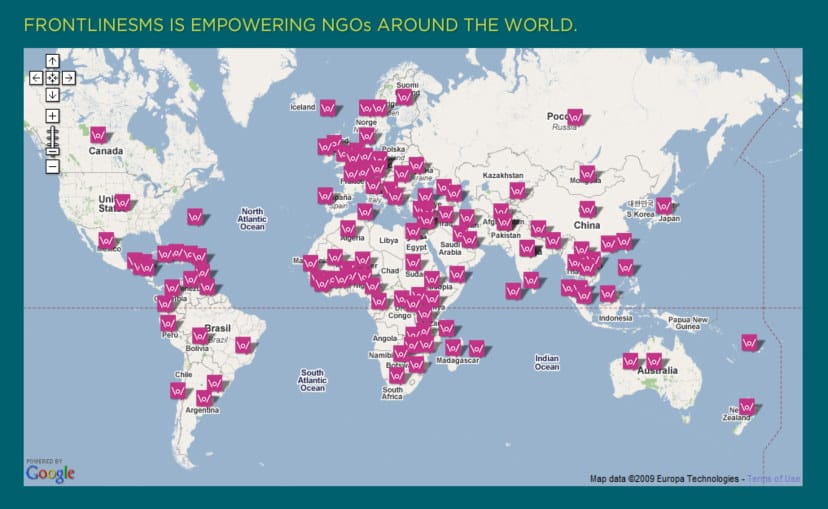
Over the years it’s been used to monitor elections in Nigeria, Afghanistan and Zimbabwe, deliver rural healthcare in Malawi, respond to disasters in Haiti, share farming and market information with communities, and keep citizens informed and connected. At its peak it powered thousands of projects in over 190 countries, benefiting tens of millions of people.
On this page we’ve brought together some of the key papers, talks, interviews and news reports which cover the development and use of FrontlineSMS from its earliest days. It is not exhaustive, and you will find more information in other sections of the kiwanja.net website.
October
2005
first Beta version released to the public
190+ countries
where it powered social change projects
Tens of thousands
of projects powered at its peak
Tens of millions
of people reached by the platform
Open source software
free software, built on everyday text messaging
Award-winning
including the Curry Stone Design Prize in 2011
Papers
Selected journal articles and papers on FrontlineSMS and mobile for development.
- FrontlineSMS: Original Fact Sheet and Proposal
kiwanja.net, early 2005. The original two-page fact sheet and proposal for FrontlineSMS, written before its first official release. - ‘Conservation News’: The release of FrontlineSMS
Oryx Journal, September 2005. - The Story of FrontlineSMS
Stanford Journal of African Studies, October 2007. - Mobile Technology and the Last Mile: ‘Reluctant Innovation’ and FrontlineSMS
Innovations (MIT Press), 2011. Written with Sean Martin McDonald and Florence Scialom, on how FrontlineSMS grew from a reluctant innovation into a tool used in over 190 countries. - FrontlineSMS: A Case Study
GSMA, April 2013. An independent case study of FrontlineSMS, covering its growth, its user-centred approach and the challenges of scaling and funding. - FrontlineSMS, Mobile-for-Development and the ‘Long Tail’ of Governance
Bits and Atoms, January 2014. A full case study examining the governance implications of FrontlineSMS deployments. - Hello World: The Making of FrontlineSMS
The Pursuit of Purpose, 2022. The book chapter telling the story of how FrontlineSMS came about.
Did you know?
A few moments from the early days, pulled from the FrontlineSMS email archive.
26 January 2005
Before it was FrontlineSMS it was “Project SMS”. The first email to use that name described the whole concept in just 963 words, with an estimated budget of £2,000.
Early 2005
The idea was conceived after field trips to South Africa and Mozambique, with the help of a bottle of beer and “Match of the Day”.
5 October 2005
To celebrate its imminent launch, FrontlineSMS bought 200 pixels on what is now an iconic piece of Internet history, The Million Dollar Homepage.
15 November 2005
An email from Kubatana, a Zimbabwean civil society organisation, led within days to the first official implementation of FrontlineSMS.
Read the full post: Seventeen things you might not know about FrontlineSMS
Website
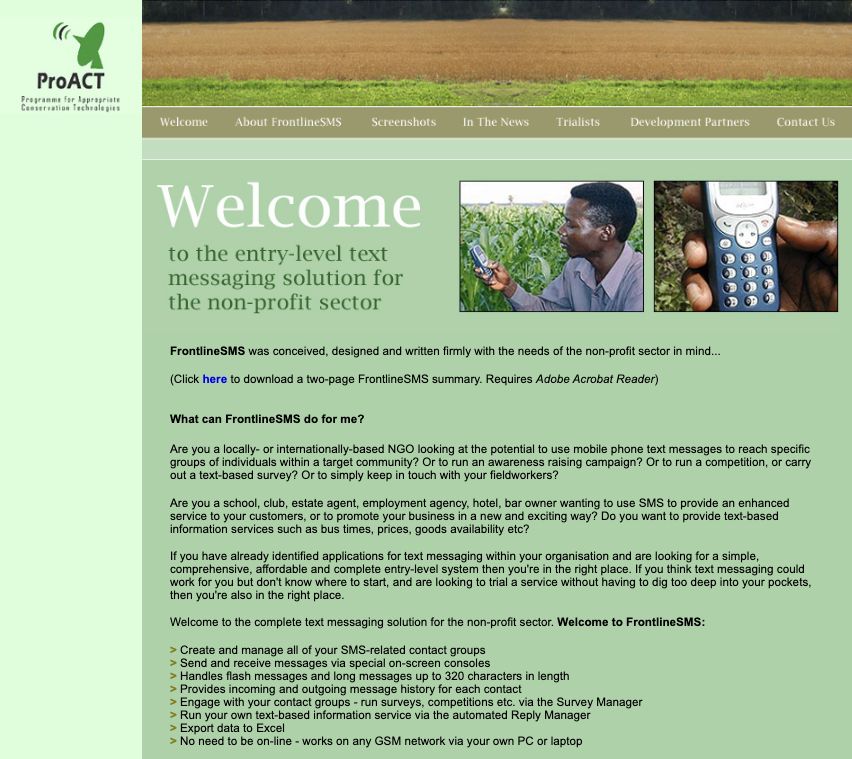
Before FrontlineSMS coding was complete, interest began building in the non-profit community. News started appearing online before the project even had a website, so coding was parked for a day and a quick website thrown together using Microsoft FrontPage. Given the lack of available content, a photograph was taken of the view outside the window in Finland, and used as the banner image. The image here is from the very first home page, published in June 2005. FrontlineSMS was publicly launched that October.
Click the image to enlarge.


In the news
Selected coverage of FrontlineSMS in the international press, in chronological order.
- Ringing the changes
Charity Times, September–October 2005. The first press coverage of FrontlineSMS, in an article by Becky Slack on how charities were using mobile phones, written before the software had even launched. Opens as a PDF. - SMS Hub In A Box
160Characters, 14 November 2005. The first public announcement following the release of FrontlineSMS, written by Mike Grenville. This link takes you to an archived copy on the Wayback Machine. - Texts monitor Nigerian elections
BBC News, April 2007. The story that brought FrontlineSMS to the world’s attention, when volunteers used it to monitor Nigeria’s presidential election. - Cats, mice and handsets
The Economist, November 2007. How FrontlineSMS was being used in Nigeria and Pakistan. A subscription is required to read it. - FrontlineSMS in rural Malawi
CNN.com, December 2008. A text-based communications network for rural healthcare, built on FrontlineSMS. - Free text messages save lives in Malawi
The Guardian, 27 March 2009. How FrontlineSMS:Medic was helping community health workers stay in touch with St Gabriel’s hospital in Namitete, Malawi, using nothing more than text messages. - Eureka moments
The Economist, September 2009. A special report story featuring the use of FrontlineSMS in activism and human rights reporting. A subscription is required to read it. - The internet: The new face of disaster reporting
The Guardian, March 2010. An editorial on the use of tools such as FrontlineSMS and Ushahidi after the Haiti earthquake. - FrontlineSMS: Mass communication where the Internet ends
Daily Maverick, August 2010. The background to FrontlineSMS and the problems it seeks to solve for grassroots non-profits. - Solving eco challenges with grassroots messaging
National Geographic, September 2010. Mobile technology and anthropology in conservation, and the role of FrontlineSMS. This is an archived version of the interview, reproduced on the kiwanja blog. - FrontlineSMS featured in Wired
Wired, June 2011. An interview about the history of FrontlineSMS, how it is used, and where the platform is headed. - FrontlineSMS, a News Challenge winner, connects people in places where the web is out of reach
Nieman Lab, June 2011. FrontlineSMS as a Knight News Challenge winner, and its plans for tools for journalists in developing regions. - Africa’s quiet digital revolution
BBC News, September 2011. Grassroots technology taking hold across the continent, including the soon-to-be-released FrontlineSMS:Radio. - FrontlineSMS Gives Radio Listeners a Voice Through Text Messages
MediaShift, October 2011. How FrontlineSMS:Radio lets listeners take part in radio programmes by text message. - How Ken Banks Built a Startup One Text Message at a Time
Forbes, June 2012. The origins of FrontlineSMS, and what it takes to build an organisation. - Questions and Answers with Ken Banks
In Focus, magazine of the UNESCO International Bureau of Education, September 2016. An interview on how FrontlineSMS emerged from work in Africa, and on technology’s role in development and learning.
The making of an SMS icon

With the support of global branding agency Wieden+Kennedy, FrontlineSMS became the first mobile development platform to create a professional, distinctive brand of its own. It was the first known case of the commercial and non-profit worlds coming together in such a way. The new logo took off in unexpected ways, with users sending in photographs of their teams with their arms in the air, representing the \o/ message of empowerment.
Videos
Video profiles of FrontlineSMS.
- Mobile at the Margins
Talk, May 2009. A ten-minute talk at the Computing at the Margins conference, Georgia Tech, on the ethos and thinking that drove the development of FrontlineSMS. - Mobile Technology: Empowering the Grassroots
Video, November 2009. Ken Banks on how FrontlineSMS helps grassroots nonprofits communicate where connectivity is limited, from Stanford’s Freeman Spogli Institute (FSI). - Ashoka Fellowship
Award profile, April 2011. The full Fellow profile is centred on FrontlineSMS – its origin, model and impact. - Curry Stone Design Prize
Award, October 2011. Awarded specifically for FrontlineSMS.
Audio & radio
Interviews and podcasts.
FrontlineSMS core values
These core values, built up over a number of years, were central to our work. Click the image to view it full size.

Each and every one is important to us: Putting users ahead – and at the heart – of everything we do, striving for a positive interaction with anyone who comes into contact with our work, aiming to inspire others whilst respecting a diversity of views, always reaching for better, fostering a positive “anything is possible” attitude, making sure we continue to put people – and their needs – ahead of the aspirations of the tech community, managing expectations both internally and for our users, and finally – constantly reminding ourselves why we do what we do.
As we continue to grow as an organisation, maintaining and reinforcing these values will be an increasingly important part of not only who we are, but who we become.
Cambridge, United Kingdom · October 2011
Blog posts
87 posts in three collections. Open any one to browse.
The FrontlineSMS story & milestones 22 posts
- In celebration of an approach less travelled (2017)
- Turning point. (2017)
- 1995. 2005. 2015. Two decades of code (2015)
- Back to the Future: Seventeen things you might not know about FrontlineSMS (2012)
- Invite: Curry Stone Design Prize Ceremony (2011)
- Rewarding open source for social good (2011)
- The FrontlineSMS trump card (2011)
- FrontlineSMS @ Tech Awards (2010)
- Scale, FrontlineSMS and the local (2009)
- FrontlineSMS wins prestigious Tech Award (2009)
- The making of an SMS icon (2009)
- The world according to FrontlineSMS (2009)
- Building our Clinton Commitment (2009)
- Call to arms: Meeting our Clinton Commitment (2008)
- Future FrontlineSMS (2008)
- A Malawian perspective on FrontlineSMS (2008)
- FrontlineSMS on the frontline (2008)
- Three years on, but still some way to go… (2008)
- FrontlineSMS and the culture of the goodie-bag (2008)
- FrontlineSMS comes of age (2008)
- From conception to replication (2008)
- The unpicking of FrontlineSMS (2007)
Field deployments & case studies 31 posts
- Mobile meets citizen reporter in Mozambique (2010)
- SMS joins battle against human trafficking (2010)
- Fishing meets texting in Banda Aceh (2009)
- Mountain-top texting for charity (2009)
- SMS tackles farmer literacy in Niger (2009)
- Mobile meets health on the margins (2009)
- An SMS “kickstart” for Kenyan farmers (2009)
- Outreach, health and SMS in Ukraine (2009)
- Update: Domestic violence – An SMS SOS (2009)
- SMS registration for Maker Faire Africa (2009)
- On a mission to aid farmers in Latin America (2009)
- Mapping medicine availability via SMS (2009)
- FrontlineSMS reaches out in Cambodia (2009)
- Mobile meets plough in Cambodia (2009)
- Missions look to SMS in Nigeria (2009)
- FrontlineSMS, media, and the Malawi elections (2009)
- Tackling domestic violence: An SMS SOS (2009)
- Human rights, SMS and the power of film (2009)
- Farmer to farmer. Phone to phone. (2009)
- Neighbourhood Watch FrontlineSMS-style (2009)
- Chipping away at the SMS literacy barrier (2009)
- Mobilising around FrontlineSMS:Medic (2009)
- TSF, FrontlineSMS and humanitarian assistance in Niger (2009)
- FrontlineSMS: Peacebuilding in Afghanistan (2009)
- Sitcoms+SMS: Tackling HIV/AIDS in the DRC (2009)
- Mobiles reach out to Azerbaijan’s youth (2008)
- SMS-powered rural healthcare in-a-box (2008)
- Cambodian farmers turn to their phones (2008)
- Zimbabweans speak out through SMS (2008)
- FrontlineSMS takes on rural healthcare in Malawi (2008)
- Kubatana reaches out with FrontlineSMS in Zimbabwe (2008)
Product, team & community news 34 posts
- FrontlineSMS @ National Geographic Live! (2010)
- FrontlineSMS at The Feast ’09 (2010)
- FrontlineSMS goes MMS! (2010)
- FrontlineSMS @ Thinking Digital 2010 (2010)
- Become a FrontlineSMS icon! (2010)
- FrontlineSMS at Google Zeitgeist (2010)
- FrontlineSMS secures new funding (2010)
- FrontlineSMS gets reminders (2010)
- Ushering in our Project Manager (2010)
- Could you be a FrontlineSMS:Intern? (2010)
- FrontlineSMS:Jobs? Yes, we’re hiring! (2010)
- Ushering in the Advisors #3: Tess, Renny (2010)
- New year, new funding, new release (2010)
- FrontlineSMS welcome video (2009)
- A fast track to SMS success (2009)
- Video intro: FrontlineSMS in agriculture (2009)
- Ushering in the Advisors #2: Larry, Jenny (2009)
- Ushering in the Advisors #1: Erik, Jan (2009)
- New team member for FrontlineSMS (2009)
- FrontlineSMS:365 (2009)
- @twitter meets @frontlinesms (2009)
- FrontlineSMS: Now with Forms (2009)
- Spreading the [text] message (2008)
- NEWS: Video of kiwanja’s Pop!Tech 2008 presentation now available online (2008)
- FrontlineSMS @ Netsquared/USAID (2008)
- NEWS: “Mobiles in Malawi” project featured on CNN.com (2008)
- NEWS: kiwanja.net and FrontlineSMS to feature on SHIFT Radio (2008)
- NEWS: FrontlineSMS updates now available via Twitter (2008)
- NEWS: kiwanja.net and FrontlineSMS featured on Danish Radio (2008)
- Students to debut FrontlineSMS on Android? (2008)
- Messaging by numbers (2008)
- FrontlineSMS gets active (2008)
- An SMS is an SMS in any language (2008)
- FrontlineSMS on a Mac? (2007)
What came next
After a management transition at FrontlineSMS in mid-2012, I turned to publishing, speaking, mentoring and consultancy. You can read more about my story and how I work with organisations today.