Our “social mobile” line in the sand

The depth and range of discussion generated by my last post on “the cloud” and “appropriate technology” may have come as something of a surprise, but one thing is clear. There’s a great deal of misunderstanding around the topic, particularly with people who are either developing or promoting tools based on the very technology I was challenging. The only way to avoid this kind of confusion is to spell out our positions clearly, and I made this point in that very same post. So how do we move on from here?

Well, we need to set out our positions clearly as a marker in the sand for future discussion. So, let me go first. To clear up any present and future confusion, here’s the official FrontlineSMS / kiwanja.net position on what I consider five key “mobile tools for development” areas – location in the “long tail”, scaling, replication and growth, open sourcing and access to “the cloud”.

1. Who are your target audience?

Some time ago I butchered Chris Anderson’s “long tail” concept and adapted it for mobile. It seemed like the best way of categorising the different focus areas for mobile tools – high-end for larger organisations down to low-end for small grassroots ones. Here’s what I came up with.
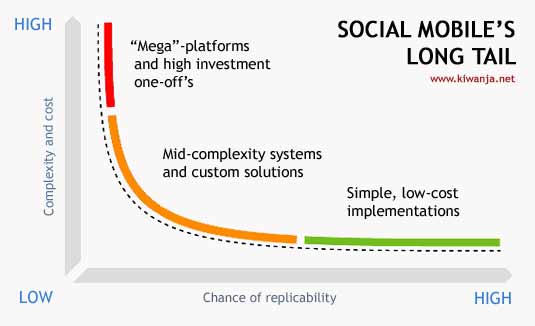
Social Mobile Long Tail, kiwanja.net

The basic rationale behind the diagram is this. Tools in the red area are technically and financially out-of-reach of many grassroots NGOs, many of whom sit in the green space. Tools at the higher end of the graph are generally more complex, server-based systems which require a high degree of technical competence, and often the Internet, to set up and use. Tools in the lower end are simple, low-cost, need few technical skills, work on easily available hardware, don’t require the Internet, and are easy to install and run. Tools in the green space can be quickly adopted and replicated – within hours – whereas tools at the other end need much more planning, i.e. more people and more lead time, and most likely a degree of training.

Note: There is no right or wrong or good or bad place on the tail. There are just different places

From its early beginnings in South Africa in 2004, FrontlineSMS has been totally focused on grassroots NGOs in the green space, an area which I believed back then was heavily underserved (and to a large degree still is). We’re not particularly interested in big users such as international NGOs or government departments. So if our tool isn’t considered right for the kinds of big projects they’re likely to be running, then that’s fine with us.

I wonder where the other social mobile tools would place themselves on the tail?

2. What is your position on scaling?

Believe it or not, not everyone wants to build tools that can grow into large centralised solutions, which is how many people seem to define scale. No one is ever going to run a nationwide election monitoring campaign running into millions of text messages using a single laptop, cable and mobile phone. FrontlineSMS is based on “horizontal scaling”, gained by an increase in the numbers of individual users with their own systems. In other words, a hundred systems in a hundred clinics serving 10,000 people each, rather than one system adapted and “scaled up” to serve a million. We’re happy and comfortable with this approach, as are our target audience of grassroots NGOs.

3. How does it replicate and grow?

Growth is based on patience, and a “pull” rather than “push” approach, i.e. awareness-raising and then letting NGOs decide if they want to try out the tool or not. Those that do then go and request it from the website. Everything is driven by the end user, who needs to be independently motivated to download and use the tool. There is no need for us to be involved at any stage, so no-one flies anywhere and no-one does any training – note that the approaches of FrontlineSMS:Medic and FrontlineSMS:Credit may be different – and no-one tries to “sell” FrontlineSMS to anyone. The solution is designed to allow users to do everything themselves. No core FrontlineSMS implementations are driven by us, and none are our projects. Use is replicated by users sharing experiences, talking about their use of the tool to others, and growing numbers of champions who are either building their own solutions around FrontlineSMS, or bloggers and researchers who write about its use and impact.

4. What is your position on open sourcing?

Again, from the very beginning we have been unashamedly focused on our end user – NGOs in developing countries seeking easy-to-deploy mobile tools. Our end users are not programmers, coders or technical developers, and few if any of our FrontlineSMS user base would have any idea what to do with source code. We decided that we would focus on the open source community once we believed we had something worth working with, and that time is about now. In between working on everything else, we plan to launch a developer community soon. That all said, there are already a number of developers bolting on new functionality to the core FrontlineSMS platform, and 90% of the code is already available online and accessible through SourceForge.

5. Does access to “the cloud” matter?

Cloud image courtesy versacevistas.wordpress.com

FrontlineSMS only came about four years ago because of a critical lack of tools that allowed for group messaging without the need for the Internet. Building a tool which is able to operate in Internet-free zones has therefore been central to our thinking since the very beginning, and continues to this day. Beyond basic messaging, FrontlineSMS can make use of an Internet connection when and where available – messages can be forwarded via email, or posted to websites, for example (that’s the functionality Ushahidi takes advantage of) – but no Internet is not a show stopper for us. And as time moves on and connectivity does improve, we’ll be ready. We’re adding picture messaging in the next couple of months (for example), and other web-based features are in the pipeline. We are not anti-Internet, but realistic when it comes to its availability and reliability.

So, that’s our line in the sand. If anyone else has a mobile tool – or is working on a mobile tool – I’d encourage them to clear up any possible confusion and write a post outlining their thinking in these five areas. The alternative is more confusion, and more false arguments and comparisons.

I know I’d love to know the thinking behind more social mobile tools, and going by the reaction earlier this week, it looks like I’m not the only one. Now is a good-a-time as any to join the conversation.

Read responses and “lines in the sand” from:

FrontlineSMS:Credit
FrontlineSMS:Medic
(As of 20th December, no other mobile tools providers have responded, which is a shame. May the confusion and misrepresentation continue…)

“Inappropriate” appropriate technology?

For some time things have been hotting up in the mobile for development space, and new tools are emerging all the time. But while these solutions extend all the way across the technological spectrum, almost all claim to be “appropriate” in one way or another. Clearly something isn’t right.

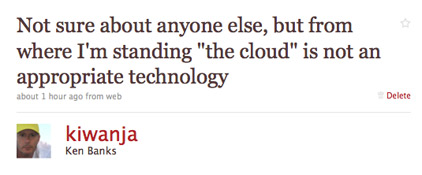
An appropriate use of Twitter?

For a while it was “scale”, and then “enabling environments”, and now it seems to be all about “appropriate technology”. I remember studying sustainable development at university, and coming to the conclusion that the term was so widely misunderstood and overused, it had almost become meaningless. I think we’re in danger of having the same thing happen with many of the terms we wildly band around in mobile. Part of the problem is that people are rarely asked to justify their positions or claims, so we never really quite know what anyone means.

In a recent PC World article I wrote, entitled “Appropriate Technology and the Humble Mobile Phone” funnily enough, I broadly defined appropriate technology as “anything that is suited to the environment in which it is used”. There are many factors that need to be considered in deciding how suitable something is – how complex it is to use, whether it can be used largely unaided, whether it can be fixed or maintained locally, how easily it can be localised, whether it can stand the field conditions, and so on.

You could also add to that whether or not the underlying infrastructure is in place for the technology to actually work. Makes sense, no? If we take anything that uses “the cloud“, for example, then I’d argue that it’s largely “inappropriate” unless you’re working in predominantly urban areas or in predominantly ‘developed’ countries. Many of the projects I see are aimed largely at the opposite – developing country and rural. On top of that, many of the areas where I’ve worked have little or no Internet access of any description, and very few people have devices that could access it, even if it was there.

In a recent must-read post – “The sun is shining in Africa” – Miquel provides some compelling arguments as to why “the cloud” is not an appropriate technology for much of the developing world:

The other big point missed in all this Cloud business is how it’s screwing the rest of the world outside of well, the US, and maybe Europe. This is the problem in how when people who proselytize a new technology don’t know understand the underpinnings of it, they often miss big gaping holes in the actual implementation of it

Maybe it’s no coincidence that there’s been a rise in use of “the cloud” and “appropriate technology” terminology at the same time. Let’s just get one thing straight, though. Technologies that use “the cloud” are not bad technologies, just as technologies which base themselves on simple SMS aren’t either. People that build and promote mobile technologies for developing regions just need to be clearer where their target audience are, and base their technology choice on what works – and what’s available – in the places where those people live and work.

Mobiles, innovation, Africa

“Innovation around the mobile phone is particularly interesting in Africa, often because it is born out of necessity”.

Over the past week, the BBC have been covering the arrival of the Seacom fibre optic cable off the coast of East Africa, focusing on Kenya initially and today moving on to Rwanda. Their excellent coverage – video, news, blogs, photos and opinion – is all brought together in a new “Connected Africa” section of their website.

BBC Online

A few weeks ago, the Editor of the BBC News Technology site asked if I could contribute an article highlighting the innovative use of mobile technology in East Africa. With all the excitement around the new bandwidth revolution, it might have been easy to forget the mobile revolution. As the BBC put it, “If you want to see how east Africa may respond to the arrival of high-speed internet links, look no further than the mobile phone market”.

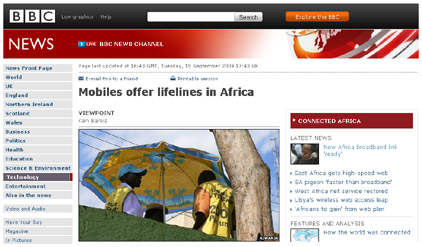
The featured article, or ‘Viewpoint’ – “Mobiles offer lifelines in Africa” – can be read here.

Considering the future of development

“Our best decisions are made when we take not only our current needs into account, but when we consider how they will be affected by the state of the world in the future”. Or so says Gustavo Montes de Oca, an intern at London-based Forum for the Future. In this guest post, Gustavo takes us through four of his key ‘development future’ thoughts, and invites you to add more by joining their ongoing discussion

A development future...The global development community is particularly focused on the future (for example, the MDGs, or Millennium Development Goals) working to future targets of poverty reduction, health improvement and equality. But what are the factors working with or against these aims, and how will they pan out in the next 20 to 30 years?

Four trends which I think will play an important part in shaping the future of development are:

First, massive growth in ICT and applications: ICT has arguably already done more for Africa than aid. With the arrival of fibre optics this will continue. $100 dollar computers in every house eclipsed by device in every pocket, serving individual and group needs. (Further information on ICTs are available in this Database of mobile applications)

Second, the “Reaspora”: People whose origins, however defined, are in the countries of Africa and southeast Asia but who live in the West have seen where that model of development leads and are taking an interest in helping their countries and regions avoid the pitfalls – and seize on the opportunities – ahead. (See sites such as the Reaspora Blog and BarCamp Africa)

Third, South – South cooperation: Cooperation between people in different low-income regions is increasing. Since they live in the same context as each other it is easiest for them to come up with solutions, including the adaptation of technologies from the developed world

Fourth, Girl effect and women in power: A woman – or girl – will reinvest 90% of her income in her family. A man will reinvest 30% – 40%. This sense of stewardship combined with growing power (two-thirds of the Rwandan Parliament is made up of women) could see women play a growing part in leading their countries down alternative, more sustainable development paths

These are my four for starters. What am I missing?

Forum for the Future is a charity committed to sustainable development which focuses on the root causes and connections between big issues such as climate change, social inequality and environmental degradation. If you would like to find out more about their work, and join in with this (and many other) discussions, visit them online at www.forumforthefuture.org