Nokia: Banking on financial services

Last November, on the day Barack Obama won the US Presidential elections, Nokia quietly lay their cards on the table and entered the ‘international development’ arena. The launch of Nokia Life Tools – initially a suite of education and agriculture-based tools aimed at the Indian market – was a significant step forward for the handset maker, which had for some time been positioning itself not just as a manufacturer, but also as something of a services provider. Early signs of any shift would have come as little surprise to those who know the history of the company. Nokia are masters of re-invention.

So, something else which shouldn’t have come as a big surprise was today’s news of Nokia’s big move into mobile financial services. There’s clearly a big market opportunity here, and Nokia have partnered with Obopay to take it on (a company they had already invested around $70 million in earlier this year). According to Nokia:

Nokia Money has been designed to be as simple and convenient as making a voice call or sending an SMS. It will enable consumers to send money to another person just by using the person’s mobile phone number, as well as to pay merchants for goods and services, pay their utility bills, or recharge their prepaid SIM cards (SIM top-up). The services can be accessed 24 hours a day from anywhere, meaning savings in travel costs and time. Nokia is building a wide network of Nokia Money agents, where consumers can deposit money in or withdraw cash from their accounts

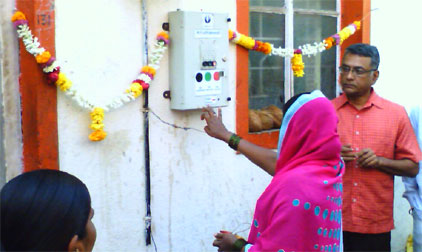
Image courtesy kiwanja.net Mobile Gallery

Although on the surface the new service may sound a little M-Pesa-esque, there appear to be some crucial differences. Details remain a little sketchy, but Nokia Money appears to be operator-independent, meaning mobile owners on any network can send or receive payments to anyone else on any other network. This would be a direct challenge to many existing models which require users to switch networks, or to be on the same network as the mobile service they’re looking to use. In addition, it looks like Nokia Money users can sign-up without needing to swap out their SIM cards, making up-take of the service considerably more efficient logistically. If this thing were to grow, it could grow fast.

We may not know all the details quite yet – Nokia will reveal more at Nokia World next week – but it is safe to say that this could be pretty disruptive. Last year, during the Life Tools launch, I wrote:

It’s the addition of Nokia Life Tools – agricultural and educational services – which raises eyebrows almost as much as it raises the bar. How will Nokia’s move into providing agricultural data and advice to farmers effect, for example, the operations of Trade At Hand, DrumNet, Manobi or TradeNet? Will they be partners in any Africa-wide venture? (Nokia do seem to be developing a habit of going-it-alone – more recently with their release of Nokia Data Gathering – rather than working with established, existing open source tools)

Image from kiwanja.net Mobile GalleryAlready the most active handset manufacturer in the developing world, today’s announcement well-and-truly places Nokia at the heart of the international development effort. As if (very) successfully designing and building low-cost handsets for emerging markets wasn’t enough, Nokia continue to increase their offering of emerging market-specific services through their low-cost phones. Last year it was agriculture and education. Today it’s financial services.

I’ve never been one for predictions, but this one has certainly come true. Again, writing last November:

So, what next? Nokia develop a mobile payments platform and embed the client into all of their emerging market handsets? Imagine, a single company controlling the entire mobile technology value chain would make interesting viewing. It could well be the answer to the age old fragmentation problems suffered by the “social mobile” and ICT4D space, but would this give the Finnish giant Google-esque powers?

So, should we be getting worried yet? At best, billions of the financially excluded finally get given a chance to enter the financial services market. At worst, M-Pesa’s monopoly in Kenya ends up looking like a minor distraction. Nokia really have taken this to a whole new level. Regulators, on your marks…

VoxAfrica TV on Africa, ICT and aid

VoxAfricaLast week I was contacted by the Production Co-Ordinator at VoxAfrica TV, a Pan African, bilingual, independent TV channel which broadcasts throughout the African continent via satellite. Following Michael Joseph’s recent comments that mobile technology has had a greater impact on Africa’s development than international aid, the producers were keen to explore the state of ICT across the continent, and I was invited to take part in a live broadcast with another guest, Tunde Adebayo, on Sunday evening.

The one hour programme – “Shoot the Messenger” – was hosted by Henry Bonsu, and features appearances from Tim Unwin (Royal Holloway), James Mbugua (Radio Africa), Samuel Burke (Hearts to Africa) and Mariéme Jamme (SpotOne Global Solutions Group and Africa Gathering).

Sadly this video is no longer available online

The video is also available on the VoxAfrica TV website.

Computer science, meet global development

What happens when you put computer scientists, user interface (UI) specialists, human-computer-interaction (HCI) designers and non-profit work together? You get ICT4D, surely? Well, maybe not as it turns out. I just spent the weekend trying to help figure out that very question at a gathering at UC Berkeley, where people from all backgrounds got together to discuss the role of computer science in global development.

I particularly enjoy workshops which bring together a mixture of people who might not ordinarily get together. On the one hand there were out-and-out computer scientists, techies and members of academia from universities all around the world, but on the other a range of people who occupy something of the middle ground. People such as Gary Marsden, Mike Best, Nathan Eagle, Kieron Sharpey-Shafer, Jonathan Jackson and others.

It was a fascinating two days. Here are a few thoughts on the tweets, tensions and takeaways from the event.

Tweet #1

It became apparent early on that there were ‘tensions’ between high-tech implementations and a need for solutions to be ‘appropriate’, i.e. simple to adopt, use and maintain. It was noted that many computer scientists – given the choice – prefer to tackle problems that are more complex, but this didn’t mean that the end solution had to be.

Tweet #2

One of the bigger obstacles was the lack of developing country experience among many computer science students and graduates, and this was seen as a major problem for the discipline. To be fair, this situation exists in the wider ICT4D and mobile fields, too. It was noted that some of the more interesting work originated from people with field experience, and that many computer science students soon realised that their earlier ideas were doomed to failure once they’d had a chance to visit the places where they hoped to implement.

Tweet #3

A question that didn’t end up being asked openly, but one that Kieran whispered to me during a wider discussion. It turns out there are all sorts of loaded terms in ‘ICT4D’ – should it be ICT in development or ICT for development, for example, and how are we defining ICT and how are we defining development? This is one I’m happy to let others thrash out.

Tweet #4

One of the more fascinating and probing questions, this time from Tapan Parikh, one of the workshop organisers. It wonderfully encapsulates one of the bigger ‘computer science for global development’ dilemmas. Does it chase down the best and smartest technologies, or simply go for solutions which promise the biggest and widest impact?

Tweet #5

Anyone who knows me will know why I make that choice. There are too many organisations spending significant amounts of time trying to stay alive and relevant, and it detracts from where their real focus should be – impact on the ground. Many of the people I know in the NGO world have dedicated their lives to their work, and they’d gladly stuff envelopes or flip burgers to keep on track. As soon as funding and ‘ownership of a space’ become higher priorities than the work itself, alarm bells begin to ring.

Tweet #6

One of the more fascinating people at the workshop was Anil Gupta, who runs the Honey Bee Network (an Indian version of AfriGadget, I guess). Anil gave an inspiring and passionate speech about the importance of grassroots innovators, and among many of the takeaways was his challenge to the proponents of scale. (If enough of us say it, maybe people will take notice).

Tweet #7

You can generally tell when things are beginning to seriously drift off-topic when people call for more conferences as the solution. I think we need to learn how to make more of the ones we’ve already got, thank you.

Tweet #8

Towards the end of a very productive two days, a topic which I expected to be deep and complex turned out to be deeper and more complex than even I expected. Just like a babysitter who hands the baby over at the end of the evening, I was grateful not to have to deal with some of these issues as I headed out the door. Sometimes it felt like there was never going to be an easy fit, but there were some very smart people in the room.

If anyone can work through these problems, they can.

Searching where Google can’t

“We read a lot about the delivery, and popularity, of SMS services such as market prices, health advice and job alerts in developing countries, information there is clearly a need for. Only last week Grameen’s AppLab initiative, in conjunction with Google and MTN, launched a suite of SMS services in Uganda. These are the services you’ll get to hear most about when you search the Web, trawl the blogosphere and attend various conferences on the subject. It all seems pretty sewn up on the content side – I mean, what else could people earning a few dollars a day (at most) possibly want?”.

Question Box. Photo courtesy Rose Shuman

kiwanja’s latest PC World article takes a look at an exciting and innovative project which started out in India but is now spreading to Africa – Question Box – which takes the internet to places where Google is yet to reach.