Open or not open? That is the question.

For many of the open source “purists” in the ICT4D field, there is only one (relatively rigid) way to run an open source project. For others – usually those who have had to actually work through the many challenges and complexities of open sourcing a piece of software – things are rarely that clear-cut. Being “open”, and “openness” in itself, can mean many different things.

Three bits of news from the past fortnight highlight how difficult and controversial being truly “open” can be.

1. Twitter

In an attempt to “ensure users can interact with Twitter the same way everywhere”, the company announced that they were considering restricting – and even blocking – access to their API for third party applications. Although this may make sense from a business or user-experience perspective, it was arguably the very explosion of these third party Twitter clients which accelerated the growth of the service. Twitter’s decision to be more strategic with their API, rather than let anyone anywhere build applications around it, is a clear attempt to regain control of the micro-blogging service. The full story is available on the BBC Technology pages.

2. Android Marketplace

Right from its inception, Apple have been heavily criticised in some quarters for the way they control every aspect of the running of their App Store. Applications are vetted and quality tightly controlled, meaning that not “any-old-application” makes it into the store. While this may be problematic for application developers, end-users (such as iPhone and iPod Touch owners) get a largely guaranteed experience – apps that work, apps that have a reasonable and familiar UI experience,  and apps that are malware and virus free. The Android Marketplace is everything that the App Store isn’t, and whilst it’s fully open and community-managed approach may make the purists purr, for the end user the experience can be much more of a challenge. You can read more on the BBC here, where the open nature of the Android platform is described as a “boon and a danger”.

3. Android Honeycomb

“In the great mobile-device wars, Google has portrayed itself as the open-source crusader doing battle against the leaders in proprietary software—Apple, Microsoft, and Research In Motion”. This argument held up strong until a couple of weeks ago when Google – again in the “interests of the user experience” – decided to delay releasing the source code of its latest Android operating system. This has caused something of a shock in the mobile world, but for others it comes as no surprise.

Problematic as they may be, these little nuggets of news confirm one thing – that the mobile industry is in a constant state of flux. Two things we can be sure of, though, are that even seemingly unambiguous terms such as “open” can never be taken for granted, and that open can never be assumed – by default – to be better than closed.


The rise of the reluctant innovator

Last month I attended the Global Competitiveness Forum in Riyadh, Saudi Arabia. More business-focused than developmental, it gave me the chance to take our work not only to a new audience, but to a new region. The “Conscious Capitalism” panel I sat on also focused on some of the questions I’ve been increasingly thinking about, and the conference theme of “innovation as a means to competitiveness” resonated.

Despite that, it was never going to be easy to get away from the fact that this was primarily a business conference. The discussion was dominated by how you might “harness innovation”, if that were ever possible. How could businesses become innovation hubs or centres of excellence? Why is it important to link the business, technology and education communities (something Silicon Valley seems to do so well)? It was a fascinating three days, but many of the delegates seemed to be missing a trick. (To be fair, many of them probably weren’t looking).

Entrepreneurs were worshipped, and business models praised, but much of the focus only took into account those people with an eye for business, or a knack for creating compelling business models, or making money. I found myself sitting in the middle of an “innovation divide”.

After a few years working in the non-profit/technology world, I’d say the landscape could be summed up as:

1. People with ideas and business models are called entrepreneurs.
2. Everyone else is an innovator.

The interesting thing for me is that, whilst the mechanics of entrepreneurship can be taught, most innovation is random, personal, demand-driven, inspired and instinctive. In short, innovation occurs naturally in the real world. Balance sheets and P&Ls, on the other hand, do not.

From where I sit, the whole “social entrepreneurship” discussion to date seems to have been dominated by the business side of things – those predominantly in the first line. Innovators unable to make a business case for their ideas struggle for visibility. To compound the problem further, for technology innovators in particular, “unsustainable” is a four letter word in their industry, resulting in even more doors closing ahead of them. Examples of fully sustainable mobile-based innovations are few and far between, as anyone who works in “mobiles for development” will know.

Innovators with world-changing ideas, solid business models and a steady income stream are the creme de la creme. They’re the ones paraded around at social entrepreneurship conferences. Many started off wanting to be “social entrepreneurs”, and many are highly ambitious and studied hard to get there. I’ve probably met hundreds over the years.

Most innovators I know never started off as such. Few remember ever saying to themselves “I want to innovate”. They’re what I’d call “reluctant innovators” – people who found themselves in the midst of a problem they felt compelled to solve. Frontline healthcare workers who see a medial problem with no solution and come up with one, or a farmer who loses a crop but finds an answer and implements and shares it. The majority of people in the developing world finding everyday solutions to everyday problems are reluctant innovators. They didn’t ask to be, they became. Real world experience was their education, not an MBA.

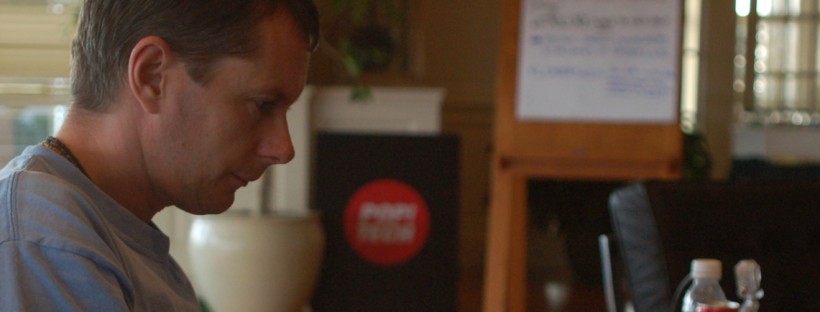
One of the best examples of a “reluctant innovator” I’ve come across is Laura Stachel, who I first met at a conference in New York back in 2009. Laura’s organisation – WE CARE Solar – designs portable solar lighting kits for maternity wards in developing countries (click the image above to watch her five minute Pop!Tech 2010 video).

When she first headed out to Nigeria, she was planning to work on something entirely different, but after realising that a simple lack of lighting was responsible for an unacceptable number of mother and child deaths – maternal mortality rates in Nigeria are among the highest in the world, with a ratio of 1,100 maternal deaths occurring for every 100,000 live births – she turned her attention to helping design, build and distribute solar kits to solve it (see photo below). Laura never intended to build and run an organisation, and never chose to become a solar innovator, but seeing a problem she felt compelled to fix, she reluctantly became one.

I would also count myself as a reluctant innovator – FrontlineSMS was never planned – and the team behind Ushahidi would likely feel the same. They were simply responding to a crisis in their country. None of us went out looking for something to solve. A problem found us, and we felt compelled to solve it.

I’d argue that most of the more successful innovations in ICT4D have come about this way – solutions created not by ‘traditional’ innovators, or technologists, but regular people who find themselves on the frontline of a challenge, and who decide to not turn their backs but to take it on. I think we can all learn from this – the social entrepreneurship sector included.

Further reading
Cometh the hour. Cometh the technology
Mechanics vs. motivation: The two faces of social innovation
Enabling the inspiration generation
Wrong model. Wrong place
Mobile technology and the last mile

Further viewing
The innovation/entrepreneurship divide

Mobile security: Going mainstream?

Spotted in the North Terminal at Gatwick Airport earlier this afternoon on a rolling electronic screen, between a car insurance and perfume advertisement (click for larger image).

“Protect yourself and your family with a robust set of security features, including advanced anti-virus technology, complete parental controls, personal data backup, and much more. Defend your mobile life

This is the first time I’ve seen a mobile security advertisement in such a prominent public space (I don’t recall ever seeing one for PC anti-virus/security software anywhere like this before – just computer shops and magazines). Are they tapping into growing concern and awareness among the general public around the security of their mobile phones?

Perhaps we’re beginning to see mobile security moving away from the domain of activism – which is where I see most of the discussion taking place – and into the mainstream. The way things are going, peace of mind for either could indeed be the new killer app.

Beyond mobile community

Tim Smit, Founder of The Eden Project, recently gave an inspiring talk at the Emerge Conference in Oxford (which I blogged about, in Tweets, here). One of the many takeaways from his talk was this:

This applies just as much to topics and subject matter as it does to people. Some of the highlights for me last year were talks I gave to “mobile-for-development-neutral” audiences. Sometimes we’re so cosy in our “m4d” bubble that we forget that many people don’t realise things like M-PESA exist, or that in the developing world patients can get medicine or appointment reminders, or that farmers can access agricultural advice, all through their mobile phones. We’ve worked for some time at FrontlineSMS to correct this, and this year has witnessed the beginnings of an acceleration of our efforts.

Since writing a travel piece for Vodafone receiver back in June 2008, I’ve been trying to figure out how we can get mobile articles into in-flight magazines. It’s the perfect neutral, captive audience, after all. Late last year, it happened.

As well as helping with the article, we also supplied a selection of photographs from our Mobile Gallery for the Brussels Airlines feature (above). Sadly, the article – “Africa’s hotbed of phone innovation” – is not available online.

We’ve also got a number of conference talks lined up this year which continue to take the “mobile message” away from purely technical or “mobile-for-development” or ICT4D audiences. Later this week I’ll be heading off to speak at the Global Competitiveness Forum in Riyadh:

The Global Competitiveness Forum (GCF), the only event of its kind, is an annual meeting of global business leaders, international political leaders, and selected intellectuals and journalists brought together to create a dialogue with respect to the positive impact organisational and national competitiveness can have on local, regional and global economic and social development

Of course, we also have The Social Mobile Group on Facebook, and our new “Mobile Message” series on National Geographic which has gained considerable traction despite only running for a couple of months. With another dozen-or-so articles still scheduled to run, we’re hoping to keep a regular column and build on their readership’s growing interest in the topic.

And finally, back to magazines, late last year I had a long chat with the Editor of National Geographic Traveller magazine, and our ‘interview’ will be featured in the magazine within the next couple of months.

Talking and writing about our work, and mobiles-for-development more broadly, is always exciting. Taking it to new places is even more so.